


Optical data storage and security labels
The volume of data that has to be stored is growing faster than the capacity of storage media. In parallel, the volume of counterfeit goods on the market keeps growing as well. Both problems require information to be written densely and read out quickly and securely.
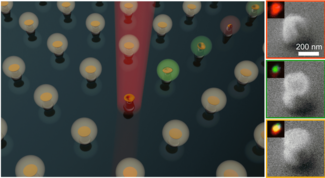
We address these problems by means of nanophotonics. Silicon particles supporting Mie resonances, hybrid metal-dielectric structures and laser-induced microstructures on metal films exhibit a pronounced spectral response in the optical range. The shape, composition and arrangement of such structures define this response, which makes it possible to encode information in it. Data can be carried by the scattering spectrum, the color, the polarization, the nonlinear luminescence or the contrast in the infrared range.
This gives rise to two lines of research that we pursue in parallel. The first one yields next-generation storage media with high recording density and fast optical readout, the second one yields security labels based on the principle of physically unclonable functions. The structure of such a label is formed stochastically, therefore its optical response is inherently non-reproducible. The authenticity of a label is verified with an ordinary smartphone camera, while recognition and matching against the database rely on computer vision algorithms.
Staff