


AI in nanophotonics
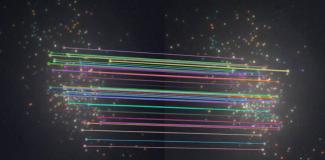
Our team actively employs computer vision and machine learning methods, particularly in projects involving physically unclonable security labels and substance analysis.
The unique nature of physically unclonable security labels requires protocols for comparing one label with another. For our labels, we develop such protocols ourselves, based on the Open Computer Vision library. When a label is read with computer vision, the position and color of each nanostructure within the label are identified. After reading, an authentication protocol is launched, comparing the information read by the user from the label with information in the database.
Substance analysis using Raman spectroscopy requires processing large volumes of spectral data, which can be quite complex due to the variety of molecular bonds of the considered substances. To solve this problem, we use machine learning. We have applied various methods to classification and regression problems, including Decision Tree, Random Forest, Support Vectors, and Logistic Regression. These methods allowed us to conduct quantitative and qualitative analysis with an accuracy of over 95%. This approach solved the problems of processing and interpreting complex spectral data and automated the analysis of large volumes of data.
Staff