


A group of researchers from ITMO University, MIPT, and universities of Germany and Switzerland have succeeded in “capturing” ultrafast hybrid light particles previously considered unobtainable. During their experiment, the physicists used a femtosecond laser and a thin metasurface with a microscopic pattern that provides the right conditions for a capture. In the future, these findings can help produce optical computing devices that are capable of self-retraining and are hundreds of times more efficient than current-day electronics. The results of the project were published in Science Advances.
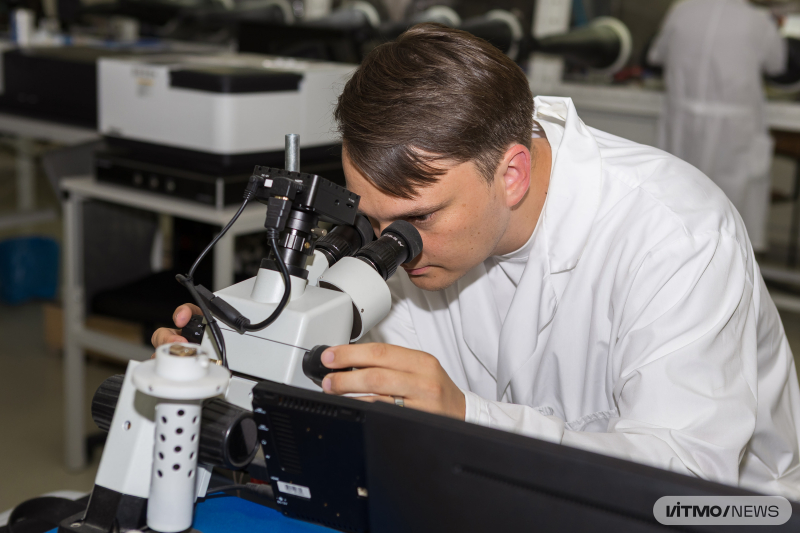
Sergey Makarov. Credit: Dmitry Grigoryev / ITMO NEWS
In physics, there is a phenomenon called the Klein paradox: it describes the behavior of particles that have almost no mass and are moving at close to lightspeed. These particles pass through barriers, meaning they cannot be “caught” in a trap and held in place. With the development of photonics, this limitation turned from theoretical to practical: in order to create optical computers, we must be able to securely hold light signals in one spot. First, to “encumber” them with data, and then – to process them on tiny sections of microchips.
A team of scientists from ITMO’s Faculty of Physics and their colleagues from the Moscow Institute of Physics and Technology, the Swiss Federal Technology Institute of Lausanne (Switzerland), and the Technical University of Dortmund (Germany) have solved this issue with the help of hybrid particles called exciton-polaritons. These particles are formed when light (a photon) is merged with an excitation of a perovskite (exciton) on a metasurface. In characteristics, these hybrids resemble massless particles that are capable of transmitting data at a very high speed.
“In our work, we used a perovskite film; this material is soft and flexible, as well as much easier and cheaper to work with than most semiconductors used in modern photonics. We need it to create the conditions in which hybrid light particles – polaritons – can be formed. Perovskite is like plasticine: you can etch any pattern you need onto it. Even at room temperature, this type of film will exhibit quantum effects that were previously achieved at ultralow temperatures. We made a film that’s 1,000 times thinner than a human hair and etched a microscopic lattice right onto it, all to make the interaction of light and matter as effective as possible,” explains Sergey Makarov, the head of ITMO’s Institute of Photonics and the chief researcher at the Faculty of Physics.
Sergey Makarov. Credit: Dmitry Grigoryev / ITMO NEWS
During their experiment, the researchers directed an ultrashort laser pulse at a miniscule dot on the metasurface. This was needed to create conditions in which polaritons would not scatter.
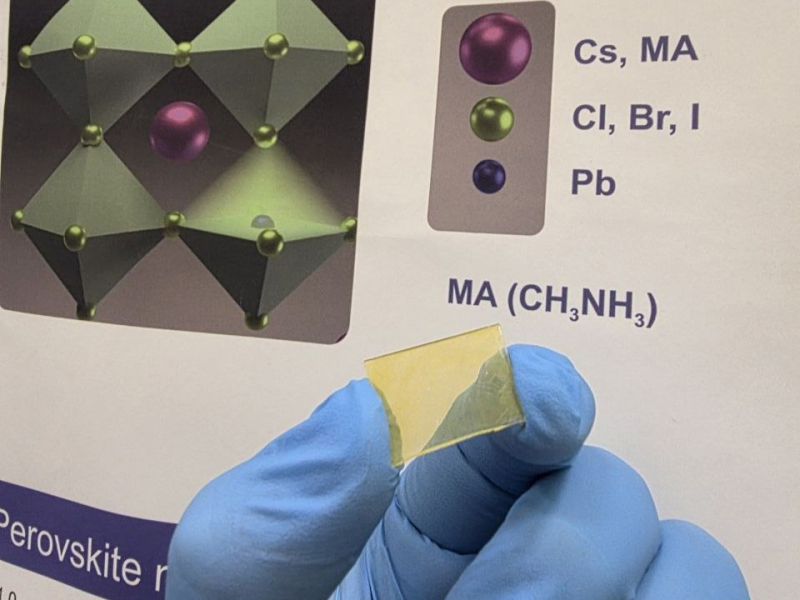
A sample of the perovskite-based metasurface, with a schematic of a halide perovskite's structure in the background. Credit: Sergey Makarov
“Light hits the tiny lasered spot and excites the perovskite there. Inside that area, we get polaritons – but they cannot move beyond the boundaries of it. Outside the impacted circle, the material remains ‘sleeping,’ unexcited. It’s like we’ve created a genie and immediately trapped it in a bottle. This balance between influx and loss of energy creates unique conditions in which we can bypass the Klein paradox and contain the particles in a trap,” comments Anton Nalitov, the study’s main theorist and a leading researcher at MIPT.
Looking through a spectrometer – a device that “filters” light by color – the researchers found that the captured polaritons had separated into clear groups by energy level. Because of this, upon exit from the perovskite film the light separated into several colored beams. This proves that the polaritons are truly captured within the trap and adopt specific states rather than scattering chaotically.
“This fundamental discovery holds promise for photonic computing. Neural networks and AI models require a great deal of computing power, while regular processors use up too much energy that’s then converted into heat. Metasurfaces like ours can complete such tasks directly via light: whereas in regular computers electrons move along wires between transistors and memory and warm up the chip, in our case light will pass through the structure within fractions of a nanosecond and carry out complex computations with minimal energy spending,” says Sergey Makarov.
The study was supported by the national program Priority 2030 within ITMO University’s strategic focus on photonic computing. In the future, the scientists plan to integrate such perovskite metasurfaces into diffractive neural networks – optical setups in which light itself performs calculations by passing through microscopically-patterned layers while a neural network processes the data. If a number of such “traps” could be placed on a compact chip about one square centimeter in size, this would make it possible to develop optical computing devices capable of, for instance, executing matrix-vector multiplication operations for large language models, image recognition, logistics optimization, and bank fraud prevention. With such technology, computations would become hundreds of times quicker and energy-efficient than today.
Share it


Последние новости
-
-
ITMO Scientists Devise Way to Apply Hybrid Light Particles in Ultrafast Optical Chips
-
ITMO Scientists First to Describe Full Photon Lifecycle in Time and Space
-
ITMO Scientists Develop New Ultrasensitive Sensor Design for Medical Diagnostics That Outperforms Counterparts
-
Light From Nowhere: ITMO Scientists Explain How Twisted Electrons Emit Photons Outside Magnetic Fields