


Axion electrodynamics
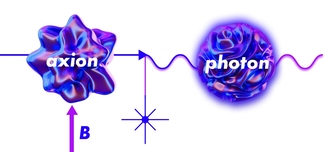

The axion was originally proposed in quantum chromodynamics to solve the strong CP problem and remains a leading dark-matter candidate. Axion electrodynamics can also emerge effectively in condensed-matter and photonic systems, where magnetoelectric couplings reproduce axion-like electromagnetic phenomena without the presence of cosmic axions.
Our group at ITMO University investigates axion electrodynamics and its realization in metamaterials. In collaboration with Nobel laureate Professor Frank Wilczek, we proposed a multilayered metamaterial with a tunable axion response and later showed that rapidly varying magnetization can generate synthetic dynamic axion fields. We have also extended this framework to nonlocal and complex-valued responses.
More recently, we predicted the dual axion response—a distinct electromagnetic property that produces the same light-scattering signatures as the conventional axion response but interacts differently with sources inside the material. We subsequently demonstrated that this response can emerge from the microscopic spin dynamics of antiferromagnetic condensed-matter systems and identified candidate materials for its realization. Our current research develops theoretical proposals to detect the dual axion response and distinguish it from its conventional counterpart, potentially opening a new direction in magnetoelectric and axion electrodynamics.
Staff