


Andrey Bogdanov, a researcher at ITMO’s International Research and Educational Center for Nanophotonics and Metamaterials and the Harbin Engineering University (China), has joined the 2026 cohort of Fellows selected by Optica – the world’s leading scientific society in optics and photonics. As an Optica Fellow, the researcher will now be eligible to influence the photonics agenda, participate in the community’s strategic initiatives, and attract new partners, PhD students, and researchers to ITMO University.

Andrey Bogdanov. Photo by Dmitry Grigoryev / ITMO NEWS
Optica Fellows are elected for their outstanding contributions to the fields of optics and photonics – in particular, for their advancements in fundamental research, engineering, business, and education. The title is one of the most prestigious distinctions in the world’s scientific community, as well as among the most difficult ones to obtain: first, a prospective fellow must be nominated by a current member based on their recommendations and achievements; and then their work is subjected to multi-layered examination that includes a review by an independent committee and approval by the Board of Directors.
As stated in Optica’s official press release, Andrey Bogdanov was recognized “for numerous pioneering contributions to the physics and applications of bound states in the continuum in resonant dielectric photonic structures.” Since 2016, he has led a research team at ITMO that studies bound states in the continuum. Under his leadership, the team has produced over 100 scientific publications, including in top-ranked international journals like Science, Physical Review Letters, Science Advances, and Advanced Materials.
Their findings paved the way for novel solutions in nonlinear optics, sensorics, and quantum engineering. The researchers demonstrated that continuum bound states can be used to significantly enhance weak light signals and efficiently convert them into light of different frequencies. The discovery made it possible to produce a compact nonlinear light source, which is crucial for telecommunications and laser medicine, as well as ultrasensitive sensors that can pick up even minor changes in the surrounding environment – particularly, in liquids and gases.
Read also:
ITMO Researchers Discover New Type of Singularity – Exceptional Bound States in the Continuum
ITMO Researchers Unveil New Methods to Control Light for Making Hypersensitive Devices
The Optical Fellow title opens a wealth of opportunities for scholars, from participating in the society’s activities to influencing the scientific agenda in photonics and exploring new avenues for international cooperation.
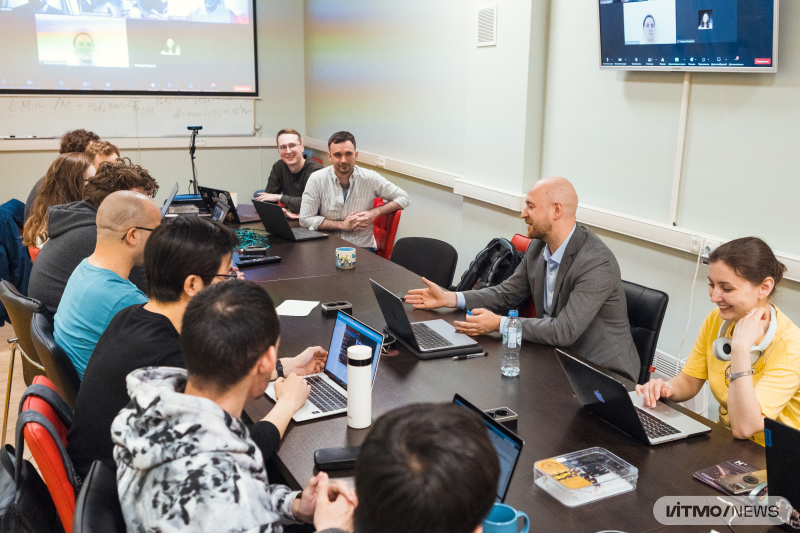
Andrey Bogdanov with an ITMO research team. Photo by Dmitry Grigoryev / ITMO NEWS
“It’s the merit of all the people we worked with – especially, our PhD students, young researchers, and our colleagues from ITMO and other Russian and global universities. Moreover, the ITMO team helped organize specialized sections at the world’s leading conferences and authored themed editions of prestigious international journals. Many of those papers were ranked among the top 1% cited ones in physics, and it helped us secure our status as one of the world’s leaders in this field,” notes Andrey Bogdanov.
The Optica charter limits the total number of Fellows to a maximum of 10% of its membership, and each year, the number of newly-elected members is capped at about 0.5% of the current membership. Since 1959, over 2,800 Fellows have been elected by the society. In 2001, Zhores Alferov, a renowned Russian scholar and a laureate of the Nobel Prize in Physics, received the title “for original investigations of heterostructure injection lasers and cw room temperature semiconductor lasers.”
Optica, formerly known as the Optical Society of America, is a top-ranked international society in optics and photonics that brings together scientists, engineers, developers, and lecturers from around the world. The organization holds major conferences, publishes reputable journals, develops educational programs, supports young scientists, and promotes science globally.
Share it


Последние новости
-
-
ITMO Scientists Devise Way to Apply Hybrid Light Particles in Ultrafast Optical Chips
-
ITMO Scientists First to Describe Full Photon Lifecycle in Time and Space
-
ITMO Scientists Develop New Ultrasensitive Sensor Design for Medical Diagnostics That Outperforms Counterparts
-
Light From Nowhere: ITMO Scientists Explain How Twisted Electrons Emit Photons Outside Magnetic Fields