


Researchers at ITMO have found a way to manipulate light in integral photonic waveguides using laser pulses. Unlike its counterparts, this particular method is thousands of times faster and done fully optically, without mechanical or electrical input. This is thanks to hybrid waves of light and matter, whose properties change when subjected to radiation. The new solution can be used to create ultra-fast optical chips that have the potential to accelerate AI calculations. The results of the study have been published in Applied Physics Letters.
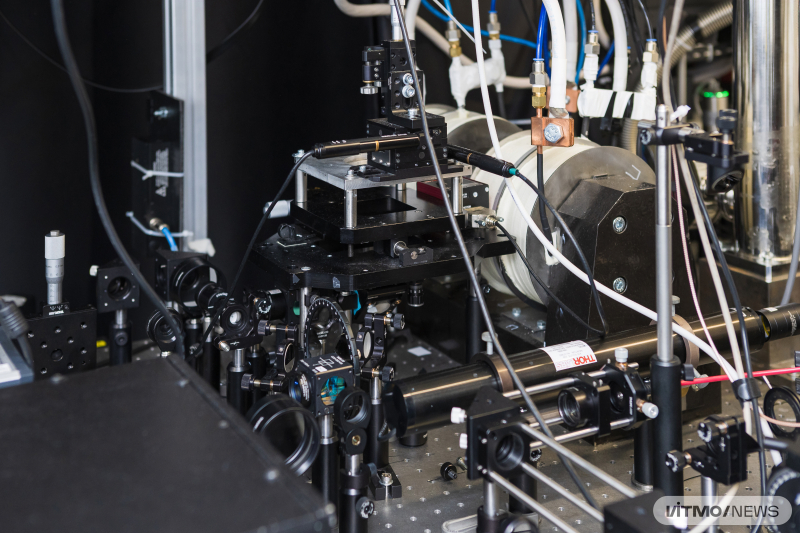
Solid immersion lens-based optical installation for measuring exciton-polaritons. Photo by Dmitry Grigoryev / ITMO NEWS
Modern electronics manufacturers strive to make their devices as compact as possible. However, there are physical limits to increasing the efficiency of small computers: metal conductors overheat, and signal transmission speeds are no longer sufficient for new tasks, especially for AI algorithms. One solution to this lies in photonic chips, where data is carried by particles of light instead of electrons. Yet, the main challenge in photonics is that light is very difficult to control, as there is still no fully optical equivalent of the transistor.
In 2023, a team of researchers from ITMO’s Laboratory of Low-Dimensional Quantum Materials developed a method of observing exciton-polaritons, hybrid optical waves with properties of light and matter. To a waveguide (a dielectric that holds light) made of tantalum oxide, they added an atom-thin layer of a tungsten disulfide (WS₂)-based semiconductor. Then, to visualize the waves, they used a miniature zinc selenide lens. At the same time, the physicists proved that exciton-polaritons can be controlled by varying the distance between the lens and the chip’s surface.
Since then, the researchers have continued their work and now they’ve found a method for superfast optical control of hybrid light. They used an improved waveguide structure: this time, the WS₂ monolayer was introduced into a dielectric waveguide made from hexagonal boron nitride; additionally, instead of moving the lens mechanically, the researchers used supershort laser pulses. These pulses change the properties of hybrid particles and make light switch faster than in a picosecond (one trillionth of a second), which is thousands of times faster than in any heat-based or mechanical processes.
The control laser pulse acts like an ultrafast switch: it “fires” into the semiconductor, creating a high density of excitons (bound pairs of electrons and holes). When there are too many of these particles, the semiconductor temporarily stops interacting with light. The hybrid bond breaks, and the light propagates further as a regular wave, but with altered parameters (speed, phase, and direction).
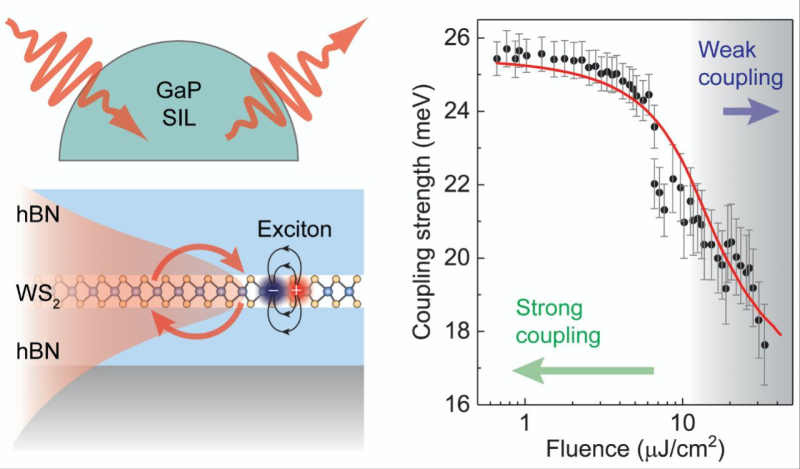
Left: schematic of exciton-polariton laser pulse control of exciton-polaritons in a hexagonal boron nitride waveguide with a built-in tungsten disulfide monolayer. Waveguide radiation is conducted via a miniature gallium phosphide lens. Right: correlation between the strength of light-exciton coupling and power of control laser pulses. Image courtesy of the researchers
To observe this process, the scientists used a miniature gallium phosphide hemisphere; this material has a higher refractive index than the zinc selenide from their previous device. This lens allows them to effectively “peer” inside the waveguide and see how the laser pulse switches the hybrid waves without disrupting the process itself. Tungsten disulfide was used for its ability to achieve strong light-matter coupling at room temperature.
“The main advantage of our approach is its speed and energy efficiency. Controlling light through heat takes microseconds, while we can make the switch faster by hundreds of thousands of times. At the same time, because the semiconducting layer is only three atoms thin, switching requires less laser power than in other optical methods. As our solution functions at room temperature, we can integrate it into real-world on-chip computing devices,” explains Vasily Kravtsov, the head of the study and the laboratory Laboratory of Low-Dimensional Quantum Materials.
Vasily Kravtsov. Photo by Dmitry Grigoryev / ITMO NEWS
The method can be used to create ultrafast optical modulators and logic elements for photonic integrated circuits (PICs). The technology is especially in demand for AI tech: hybrid chips, where electronics work in tandem with photonics, can perform the relevant matrix computations much faster.
In the next 2-3 years, the research team is planning to develop a functional prototype of an on-chip optical modulator, where switching will happen at specified points of the waveguide. In the future, these chips can be used in supercomputers and telecommunication equipment.
This study was supported by Russian Science Foundation (grant No. 25-72-20030) and national program Priority 2030.
Share it


Последние новости
-
-
ITMO Scientists Devise Way to Apply Hybrid Light Particles in Ultrafast Optical Chips
-
ITMO Scientists First to Describe Full Photon Lifecycle in Time and Space
-
ITMO Scientists Develop New Ultrasensitive Sensor Design for Medical Diagnostics That Outperforms Counterparts
-
Light From Nowhere: ITMO Scientists Explain How Twisted Electrons Emit Photons Outside Magnetic Fields