


Researchers from ITMO University are the first to demonstrate that twisted electrons – particles that not only orbit but also create a sort of quantum vortex in accelerators – can reach immense speeds without losing their quantum properties. These particles proved to be more efficient in high-quality electron and ion microscopy and can be used to study the properties of nuclear forces and the previously inaccessible quantum effects in accelerators. Earlier, no model could accurately describe the acceleration of twisted particles and the conditions for maintaining their twisted state. The findings of the Russian Science Foundation-supported study are published in Physical Review Letters.
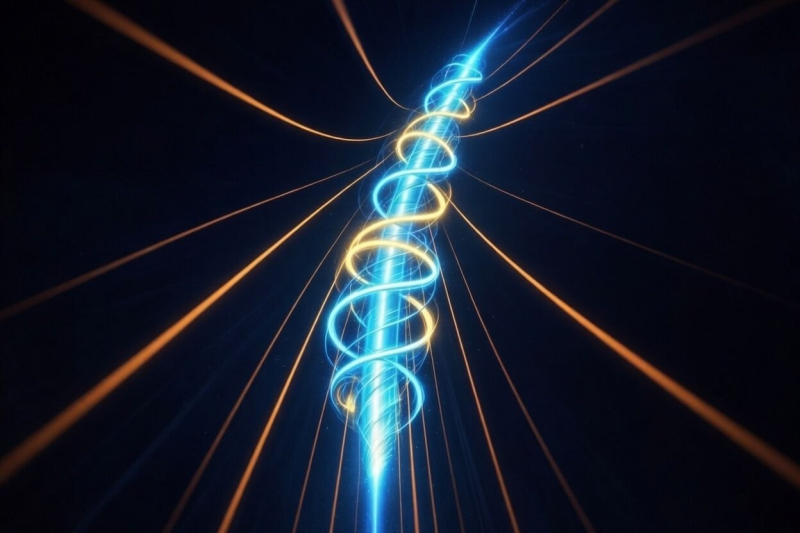
An AI-generated image of a twisted electron, i.e. a particle circulating around a trajectory of the density function movement. Photo courtesy of Dmitry Karlovets
When a charged particle, for example, an electron, is placed inside a ring accelerator, it begins to rotate at a tremendous speed under the influence of magnetic fields. However, there are particles, often termed twisted, that don’t just spin around the outer center but also create a sort of quantum vortex; they are generated in electronic microscopes to study the magnetic properties of materials. Until now, scientists had failed to accelerate such particles to near-light speeds in accelerators without breaking their twisted state. Therefore, they could not collide them to study the yet-unknown quantum phenomena – such as quantum coherence and entanglement – which could potentially benefit the fields of microscopy, quantum optics, and accelerator physics.
As a solution, scientists at ITMO University have proposed a mathematical model that explains how to preserve the "twistedness" of particles at high speeds; they managed to calculate the behavior of twisted electrons in accelerator fields and described two fundamental processes that cause particles to lose their state.
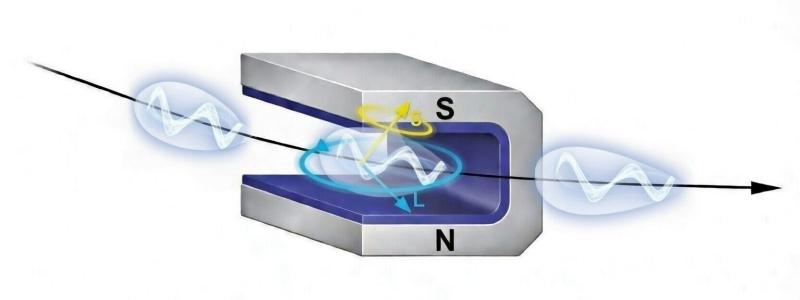
In the magnetic field of a ring accelerator or a magnet, the electron spin S and its orbital angular momentum (twistedness) undergo precession – they rotate around the magnetic field with varying frequencies. Photo courtesy of Dmitry Karlovets
First, charged particles in an accelerator’s magnetic field lose their energy by emitting photons, also known as light particles. Scientists believed that for twisted particles this also meant losing their state. Nevertheless, the calculations showed that this hardly ever happens.
Second, charged particles interact with the accelerator’s fields through its magnetic momentum (akin to a miniature compass needle), which may disrupt the particle's motion parameters. The calculations show that for twisted particles, these disruptions happen at energies 147 times lower than for ordinary electrons. To avoid this effect, the researchers suggest switching from a ring to a linear accelerator or employing specialized equipment: for example, a technology developed at the Budker Institute of Nuclear Physics in Novosibirsk that can rotate a particle’s magnetic momentum, thus adjusting its movement.
“So far, there had been no reliable and accepted model that would describe the movement of twisted particles at high energies. Our calculations offer a detailed analysis of different mechanisms behind the loss of this state and suggest methods to sustain it as the particles reach higher energy levels. In the future, we plan to confirm the accuracy of our findings by conducting accelerator experiments,” says Dmitry Karlovets, DSc in physics and mathematics, the head of the project and a senior researcher at ITMO’s Faculty of Physics.

Members of the research team. Photo courtesy of Dmitry Karlovets
Written by the press office of the Russian Science Foundation
Share it


Последние новости
-
-
ITMO Scientists Devise Way to Apply Hybrid Light Particles in Ultrafast Optical Chips
-
ITMO Scientists First to Describe Full Photon Lifecycle in Time and Space
-
ITMO Scientists Develop New Ultrasensitive Sensor Design for Medical Diagnostics That Outperforms Counterparts
-
Light From Nowhere: ITMO Scientists Explain How Twisted Electrons Emit Photons Outside Magnetic Fields