


Scientists from ITMO University and Peking University (PKU) have developed a compact, energy-efficient memory component that acts as a microscopic light “trap” in a silicon photonic structure. Compared to alternatives, the device requires power of around 200 μW and can switch between multiple optical states, which is essential for high-speed optical data processing. In the long run, the technology can pave the way for ultra-fast, energy-efficient optical memory and optical AI processors. The results of the relevant study are published in Nature Nanotechnology.
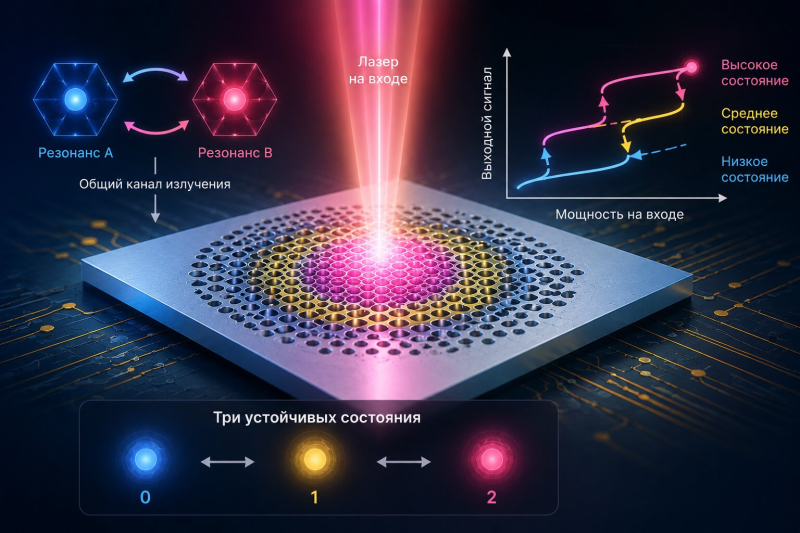
A silicon-based optical memory chip: microresonators switch between three stable states of light that can be used to store information. Illustration by the researchers
One of the biggest challenges in modern photonics is light-based processing and storage of information that does not require constant conversion of an optical signal into an electrical one and vice versa. This body of work will pave a way towards future optical computers, communication systems, AI, and optical neuromorphic computing.
Such systems are not possible without ultra-compact, energy-efficient optical elements that not only understand binary (0 and 1) – but can also support multiple stable states. The same element can store a low-, medium-, and high-level optical signal, which can be deployed to store and process data using light. Switching between these states is triggered by light pulses. However, forcing light to change its state is not an easy task; it often requires bulky, powerful, and energy-demanding lasers. At the same time, for integrated photonics, it is vital to reduce energy consumption needed for the switch, as the less energy required, the more elements can be placed on a chip.
Researchers from ITMO University and Peking University solved this issue by developing a microscopic light “trap” on a custom-built silicon chip that combines compactness, energy-efficiency, and a high Q factor (the efficiency of a given system in terms of light capture).
Initially, the physicists strived to place not one, but several resonances with similar frequencies within one compact system and connect them via a shared radiation channel. As resonances “trap” light inside the microstructure and enhance its interaction with the material, the scientists were able to reach a high Q factor of about one million, at which even an ultra-low power input causes a powerful nonlinear optical response and bound light in three states.
The researchers produced an experimental sample of optical memory that measures less than 20 μm in diameter – significantly thinner than a human hair – and consumes as little as one mW in energy. In essence, the team created a prototype of optical random-access memory (RAM) – and demonstrated that light pulses can switch between three states, each of which remains stable until the next switch.
This breakthrough brings more compact and energy-efficient elements for next-gen optical computing systems one step closer.
“At this stage, we’ve developed a functional experimental sample, not a market-ready device. We showed how optical memory works, produced samples, and experimentally proved that a compact silicon-based unit can function as a multilevel memory cell that stores several stable states of an optical response. This method can already be used to study complex optical switching, optical memory, and other nonlinear photonic components. However, for practical use, we still need to figure out how to scale up the technology, integrate it with other elements of photonic circuits, and boost its speed and performance in more complex architectures. This study aligns with ITMO’s focus towards integrated photonics,” shares Andrey Bogdanov, an author of the study and a researcher at ITMO’s International Research and Educational Center for Nanophotonics and Metamaterials.

Andrey Bogdanov. Photo by Dmitry Grigoryev / ITMO NEWS
Next, the team plans to move from single elements to microresonator arrays to produce more complex photonic circuits: logic units, memory matrices, and neuromorphic photonic processors. They also want to increase the number of stable states supported by the system; this will help create advanced multilevel optical units, optimize the design, accelerate the development process, and study how these microresonators can be integrated into real-world photonic platforms with waveguides, light sources, sensors, and control electronics.
The study is supported by the national program Priority 2030.
Share it


Последние новости
-
-
ITMO Scientists Devise Way to Apply Hybrid Light Particles in Ultrafast Optical Chips
-
ITMO Scientists First to Describe Full Photon Lifecycle in Time and Space
-
ITMO Scientists Develop New Ultrasensitive Sensor Design for Medical Diagnostics That Outperforms Counterparts
-
Light From Nowhere: ITMO Scientists Explain How Twisted Electrons Emit Photons Outside Magnetic Fields