


PeroSeminar | 23 May 2024
begins at
23 Май 2024
11:00 AM (GMT +03:00)
location:
2201 (PeroLab) + Online
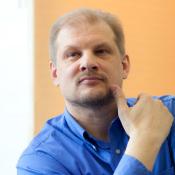
Dr. Pavel A. Frantsuzov
Voevodsky Institute of Chemical Kinetics and Combustion, Siberian Branch of RAS Novosibirsk, Russia
The mystery of blinking dots
Every week we will send you an e-mail with a digest of scientific events. Subscribe and wait for an e-mail!
Abstract
A striking puzzle was raised two decades years ago by the spectroscopic experiments on single colloidal quantum dots (QDs). Observing the fluorescence of a single QD under continuous light excitation one can see that the intensity of its emission fluctuates with time (blinks). Even more interesting, these fluctuations do not have characteristic time scale. It means that these fluctuations can be observed at milliseconds, seconds, and thousands of seconds, sometimes hours. The mystery lies precisely in what causes blinking over such a wide range of times in such a small object only a few nanometers in size. Despite the fact that researchers have been studying this phenomenon for more than 20 years and thousands of articles have been published on this topic, it cannot be said that we already have a final solution to this mystery.
We consider the properties of the QD blinking properties, the mechanisms and models of blinking suggested in the literature.
Последние новости
-
-
Ученые ИТМО впервые описали полный жизненный цикл фотона во времени и пространстве
-
Всероссийский День физики в ИТМО
-
В ИТМО разработали новый дизайн сверхчувствительного сенсора для медицинской диагностики — он в разы точнее аналогов
-
Свет из «ниоткуда»: ученые ИТМО объяснили, как закрученные электроны испускают фотоны вне магнитного поля