


Quasicrystalline structures
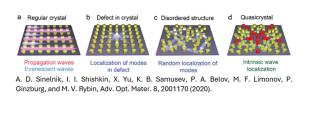
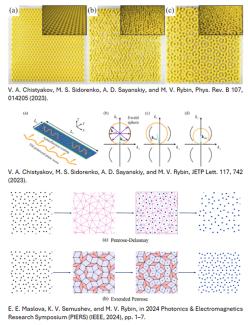
Quasicrystalline photonic structures have an intermediate position between periodic photonic crystals and completely disordered systems, enabling band gap formation and selective narrowband scattering for significantly lower refractive index contrast. The approach is based on inverse design in reciprocal space: the desired permittivity distribution is achieved through Fourier components located along arcs on the Ewald sphere, providing frequency-angular selectivity of incident wave scattering. This method drives the design of structures with low dielectric contrast, offering efficient absorption of electromagnetic energy over a narrow range of frequencies and angles of incidence.
The creation of two-dimensional quasicrystalline structures with a complete photonic band gap for record-low refractive index contrast has been confirmed experimentally: the suppression of radiation from a dipole placed at the center of the structure agrees with full-wave modeling. A separate line of research is devoted to the fundamental question of whether periodicity is necessary for band gap formation. Comparison of a photonic crystal, a disordered lattice, and an ordered but non-periodic quasicrystal revealed that the quasicrystal and the disordered lattice exhibit nearly identical suppression of the density of photonic states, despite their different degrees of order. Furthermore, in three-dimensional defect-free quasicrystals, intrinsic light localization has been experimentally detected, associated not with disorder, but with the aperiodicity of the structure, which leads to uncompensated multiple scattering inside the sample.
Staff



Publications
There are no publications